
Confidential legal representation in Kuala Lumpur, Selangor & selected areas in Malaysia
White-Collar and Commercial Crime · Cyber Crime · AMLA / Money Laundering · Family Law · Legal Aid

Can Your Business Be Charged With Corruption If Your Employee Gives A Bribe To Secure A Contract For The Business?

 
Yes. In fact, the law does not only limit liability to the conduct of the organisation’s employees. Section 17A(1) of the Malaysian Anti-Corruption Commission  Act (MACCA) 2009 states that a commercial organisation can be criminally liable for corrupt conduct by a person associated with the organisation. This is known as corporate liability.
 
The person associated could be a director, partner, employee or an agent acting as an extension for your business.
 
A brief overview of Section 17A(1) MACCA 2009 is that where a person associated with a commercial organisation gives, agrees to give, promises or offers any bribe to any person with the intention of obtaining or retaining a business or business advantage for the commercial organisation, the commercial organisation itself commits an offence.

But there is another sting in Section 17A MACCA 2009.

Section 17A(3) MACCA 2009 provides that where an offence under Section 17A(1) MACCA 2009 has been committed by a commercial organisation, then a director, controller, officer, partner or person concerned in the management of the organisation’s affairs may also be deemed to have committed the same offence. This is an important deeming provision as it shifts the burden of proof from the prosecution to the director and the senior management. In practical terms, an employee who corruptly bribes another entity for the benefit of the company may not only expose the company to criminal liability, the consequences may also extend to the company’s directors and senior management, individually.
 
However, this deeming provision comes with an important qualification. The individual is deemed to be liable unless it is proved that the offence was committed without their consent or connivance, and that they exercised the diligence that ought to have been exercised to prevent the commission of the offence, having regard to the nature of their functions and all the circumstances.
 
Naturally, one might also ask “I didn’t know about the bribe and I did not give my consent. Will I still be implicated?”
 
Here, it is important to distinguish between the liability of the commercial organisation and the liability of the individuals concerned in its management.
 
Section 17A(1) MACCA 2009 focuses on the conduct and intention of the person associated with the commercial organisation who gives, agrees to give, promises or offers the gratification. Consequently, the commercial organisation itself commits the offence.
 
As for the individuals referred to in Section 17A(3) MACCA 2009, the provision expressly allows them to rebut the deeming provision.
 
The Federal Court in Public Prosecutor v Gan Boon Aun [2017] 3 MLJ 12 considered the constitutionality of a similar deeming provision under the then Securities Industry Act 1983 (now the Capital Markets and Services Act 2007). The Federal Court held, in substance, that the provision did not simply deem the accused guilty. Rather, the deeming provision could be rebutted through the statutory defence provided by the legislation.
 
The case concerned a different statute and a different deeming provision, so it should not be treated as a direct interpretation of Section 17A MACCA 2009 here. Nevertheless, it shows an important distinction, a statutory deeming provision is not necessarily the same as a conclusive presumption of guilt.
 
So, is there a statutory defence to prevent your business from being caught by Section 17A(1) MACCA 2009?
 
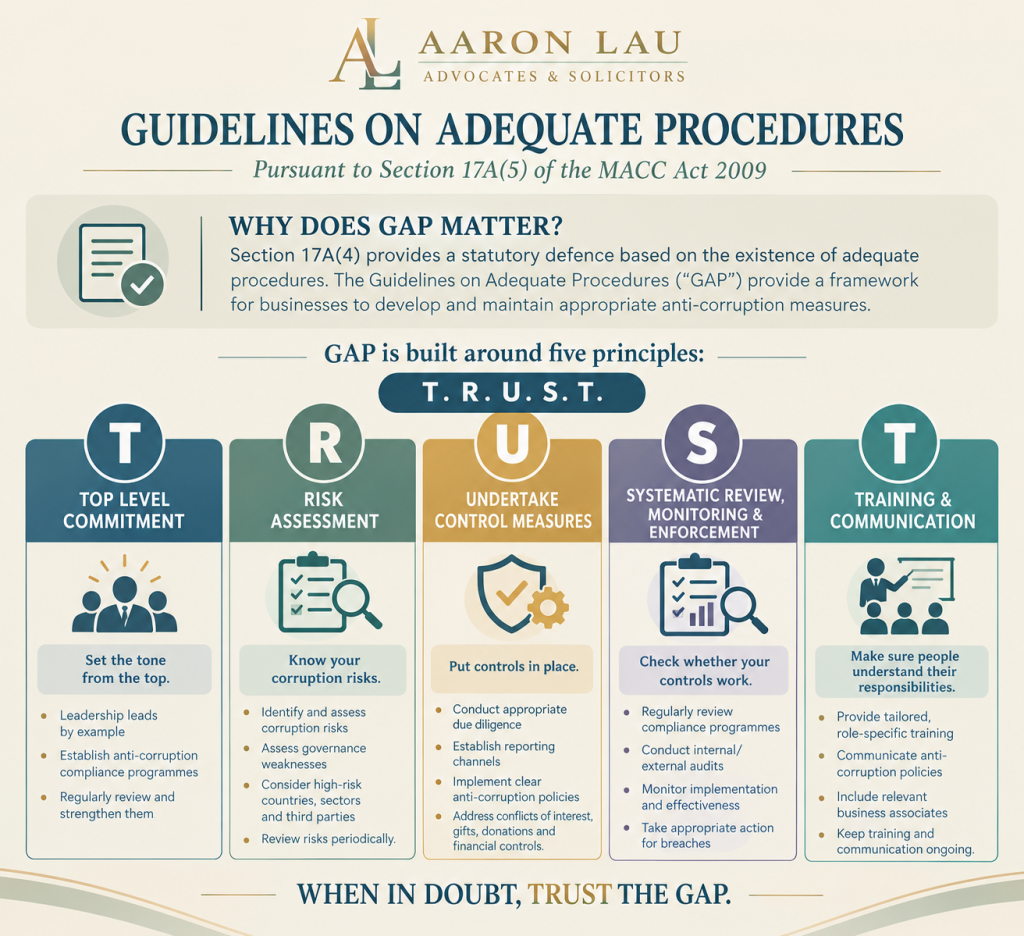
Yes. Section 17A(4) MACCA 2009 provides a statutory defence for the commercial organisation where it can prove that it had adequate procedures designed to prevent persons associated with the commercial organisation from undertaking corrupt practices.
 
What exactly are these “adequate procedures”?
 
The Prime Minister’s Department issued the Guidelines On Adequate Procedures (GAP) pursuant to Section 17A(5) MACCA 2009. GAP introduces five principles, namely T.R.U.S.T.:-
 
  • T – Top Level Commitment

    The leadership of the business should set the tone from the top. Directors and senior management should lead by example by setting up anti-corruption compliance programmes and review them from time to time.


  • R – Risk Assessment

    A business should identify and assess the corruption risks and conduct appropriate assessment of the risks it faces. GAP recommends that a comprehensive risk assessment ought to be done every three years.

    This assessment should focus on evaluating internal governance weaknesses, financial transactions that may disguise corrupt payment, business links in high risk countries or sectors and relationships with third parties connected to its business operations.


  • U – Undertake Control Measures

    Once a risk has been identified, the business should establish appropriate measures as risk management. This may include conducting internal due diligence on key personnel such as board members, employees, agents, vendors, contractors, etc, before entering into a formal contractual relationship.
    Further, businesses should provide a reporting channel for whistleblowers to report on such risks.

    It is also recommended for a business organisation to set up clear anti-corruption policies covering conflict of interest, gifts, donations, and financial/non-financial control, to name a few.
     
     
  • S – Systematic Review, Monitoring and Enforcement


    GAP recognises that a business should regularly review the effectiveness of the anti-corruption compliance programmes and whether they are adhered to. The top level management can do so by conducting an internal audit or an external audit.

    A business should also establish and maintain a monitoring programme to regularly assess its anti-corruption procedures. An internal audit should be conducted by competent personnel to evaluate whether those procedures are being properly implemented and remain effective. Whereas, an external audit can be carried out by a qualified and independent third party such as an ISO 37001 auditor.

     
  • T – Training And Communication

    The business should provide tailored and role-specific continuous training to employees and business associates related to their anti-corruption compliance programmes. The organisation’s stance on its anti-corruption policy should be publicly disclosed and internally communicated.

As a business grows, its corruption risks may change. A company that previously dealt only with private customers may eventually begin dealing with government agencies or large procurement contracts. Consequently, comprehensive anti-corruption policies should therefore be reviewed and updated accordingly.

Ultimately, the question to be asked is not only “Did my company know about the bribe?”, one must also ask “What did my company do to prevent the bribe from happening in the first place?”

That said, as of the time of writing, the statutory defence under Section 17A(4) MACCA 2009 has yet to be tested by the Malaysian courts.

However, businesses would be well advised to take proactive steps to understand and implement adequate procedures appropriate to their corruption risks.

Disclaimer: This article serves as general information purposes only, and does not constitute as professional or legal advice. Legal advice should always be sought before taking any action or refraining from taking any action based on its own facts.

If you require legal advice or wish to enquire about a matter discussed in this article, please contact us for further assistance.


How the first enquiry works

The enquiry process helps you understand what to prepare and how we can assess the next legal steps.

1. Confidential enquiry

Share the nature of your matter through the contact form or your preferred enquiry channel. Alternatively, click here to make an enquiry.

2. Initial review

We consider the issue, its urgency, the available information, and the key documents involved.

3. Legal direction

You receive practical guidance on possible next steps and what may need to be prepared.

4. Representation

Where representation is required, the matter is handled with preparation, care, and discretion.