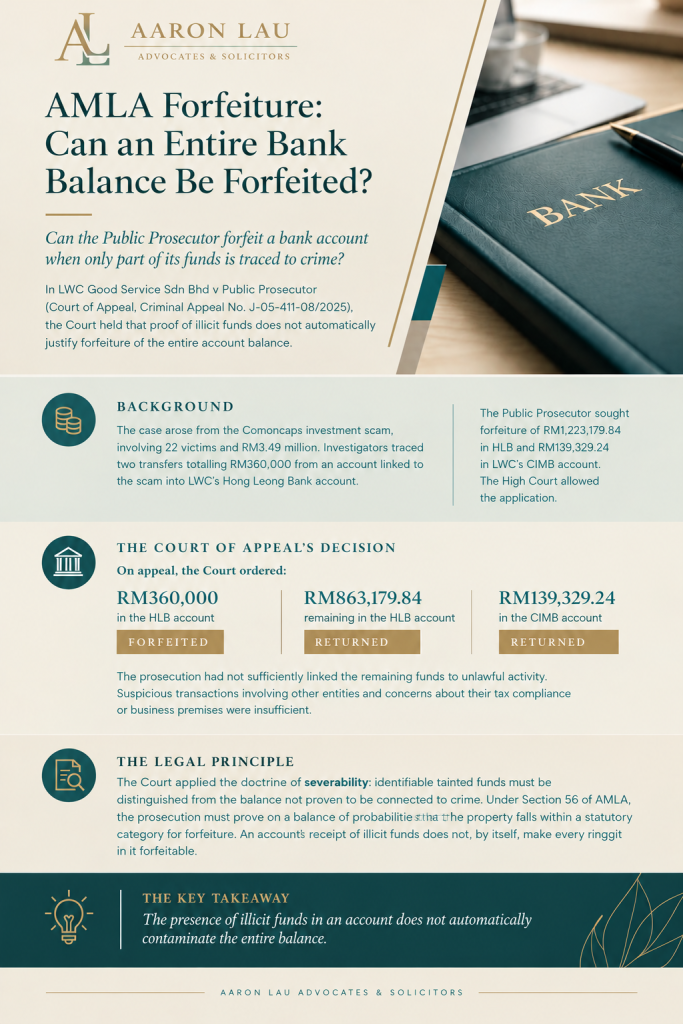
Can the Public Prosecutor forfeit the entire bank account simply because part of the money deposited into it is traced to criminal activity?
The Court of Appeal in LWC Good Service Sdn Bhd v. Public Prosecutor [2026] CLJU 3798 addressed this question by drawing a clear distinction between funds identifiable through investigation which are proven to be proceeds of unlawful activity and the remaining balance for which no evidentiary nexus linking it to a predicate crime.
This case arose from an online investment scam known as “Comoncaps”, which upon investigation, the total defrauded proceeds, involving 22 victims identified by the enforcement authorities, amounted to approximately RM3,490,153.82.
Through financial forensic tracing, it was ascertained by the investigating officers that two transfers amounting to RM360,000.00 was traced to a Hong Leong Bank account belonging to LWC Good Service Sdn Bhd (“the Appellant”).
The Public Prosecutor then applied under Section 56 AMLA 2001 to forfeit the entire balance in the Appellant’s Hong Leong Bank account, totalling to RM1,223,179.82, together with RM139,329.24 in its CIMB account.
The High Court allowed the forfeiture application by the Public Prosecutor in full. Aggrieved by the decision, the Appellant appealed to the Court of Appeal against the decision of the High Court.
The Court of Appeal allowed the Appellant’s appeal in part. It ordered the forfeiture of RM360,000.00, which the prosecution had directly traced to the investment scam, but directed the release and return of the remaining RM863,179.84 in the Hong Leong Bank account and the entire RM139,329.24 in the CIMB account to the Appellant.
The Court held that although the prosecution was not required to trace every commercial transaction down to the last cent, it still had to establish an evidential connection between the property sought to be forfeited and the unlawful activity.
In this case, the prosecution successfully established a direct, unbroken evidentiary money trail showing two transfers amounting to RM360,000.00 from a mule account holding the illicit funds from Comoncaps, straight into the Appellant’s Hong Leong Bank account.
In relation to the remaining sums of RM863,179.84 in the Hong Leong Bank account and RM139,329.24 in the CIMB account, the prosecution’s reliance on suspicious transactions involving other business entities, including concerns about their business premises and tax compliance, was held to be insufficient to establish that the remaining balances were proceeds of unlawful activity.
The Court applied the doctrine of severability, under which the proven tainted funds could be separated from the remaining balance that had not been shown to be connected to the alleged criminal activity. It further held that Section 56 AMLA 2001 could not be used as a blanket mechanism to confiscate funds merely because an entity’s corporate profile is irregular or its trading partner is non-compliant.
Therefore, in the absence of evidentiary nexus to link the remaining sums as being derived from the Comoncaps predicate scam, a blanket forfeiture would amount to an unconstitutional deprivation of property without authority of law under Article 13 of the Federal Constitution (right to property) and exceeds the mandate of Section 56(2) AMLA 2001.