

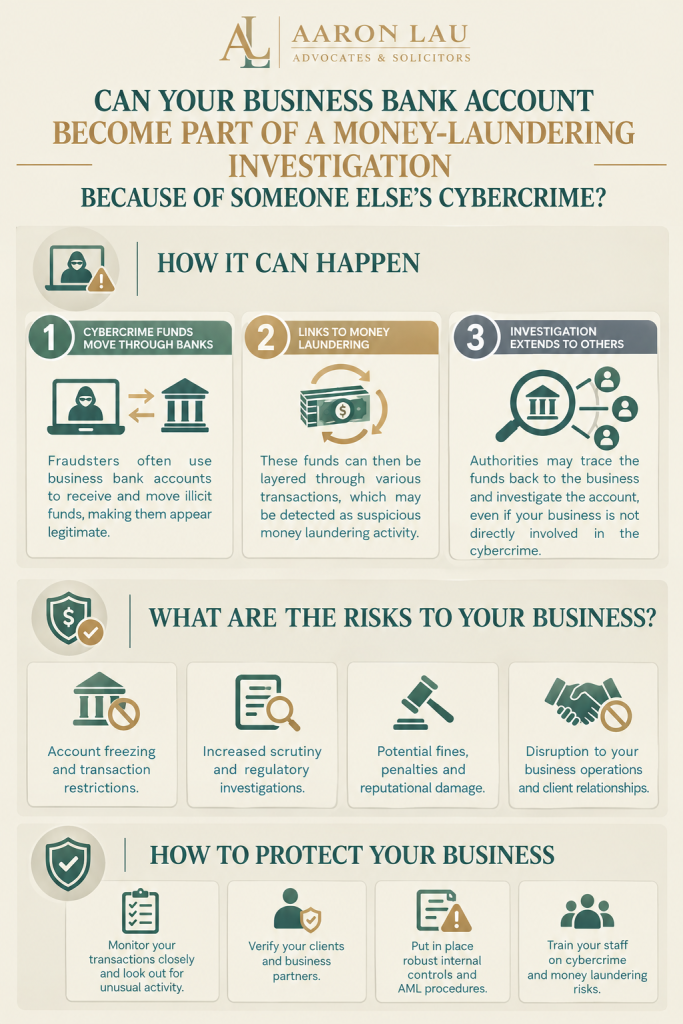
There are situations where legitimate businesses and business owners have fallen victim to cybercrime. In certain cases, these businesses became unwitting recipients of funds connected to the cybercrime, causing the business owners to appear, at least at the onset of the criminal investigation, to be complicit in the crime. For some of these businesses, the investigations were discontinued after sufficient evidence were provided during the investigation to show that they were legitimate business owners who had themselves fallen victim to the scheme. In other cases, the situation may not be as straightforward.
Realistically, not every business owner knows where every ringgit and cent entering into their company’s bank account comes from? Imagine a company’s bank account receives a payment from a new customer where the invoice looks legitimate and the amount matches the invoice. As far as the owners are concerned, it is just another day at the office, another payment received in fulfillment of a contractual obligation between their company and their customer. They think nothing more of it and move on to the next customer.
-
Have your own KYC system to verify the identity of your new customers, particularly their company registration details. Always, verify the names of the authorised signatories before executing any contracts and identify if the nature of their registered business matches and is consistent with the transaction.
-
Look out for third-party payments made into your company’s bank account involving invoices paid by business entities or individuals who are not the original parties to your business agreements. While there could be legitimate reasons for customers to make payments to your business through third parties, such arrangements pose risks where the source of funds from the third party is unclear. In practice, business owners who conduct customer due diligence on those they choose to do business with, may not necessarily extend the same level of scrutiny to the third party making the payment. Yet, once payment is made into your business bank account, the identity and source of those funds may become just as important as the identity of your customer.
-
Do not withdraw, move or transfer the money so hastily. If you suspect that your business may have received funds connected to a cybercrime or money-laundering scheme, do not attempt to “fix” the situation by hastily withdrawing, moving or transferring the funds, particularly to another account at the request of anyone. Doing so may complicate the situation and potentially expose you to allegations of being an unwitting money launderer in the laundering chain. Instead, gather the relevant paper trail leading to the transaction, and immediately notify your bank and seek appropriate legal advice before taking further action.
-
Train your staff to recognise red flags as oftentimes, employees tasked with handling customers, invoices, payments and refunds are the first line of defence in detecting suspicious transactions. Even if a business is not subject to AML/CFT requirements, business owners should recognise the importance of Anti-Money Laundering programme in which staff training forms an integral part. An effective AML programme could reduce risks and strengthen the ability to identify the warning signs of potentially suspicious transactions at an early stage.
You may not be able to control who attempts to misuse your business, but you can definitely control how prepared your business is to recognise the warning signs. Know who you are dealing with, where your money is coming from and always question suspicious transactions that do not make commercial sense.
Disclaimer: This article serves as general information purposes only, and does not constitute as professional or legal advice. Legal advice should always be sought before taking any action or refraining from taking any action based on its own facts.
If you require legal advice or wish to enquire about a matter discussed in this article, please contact us for further assistance.
How the first enquiry works
The enquiry process helps you understand what to prepare and how we can assess the next legal steps.
1. Confidential enquiry
Share the nature of your matter through the contact form or your preferred enquiry channel. Alternatively, click here to make an enquiry.
2. Initial review
We consider the issue, its urgency, the available information, and the key documents involved.
3. Legal direction
You receive practical guidance on possible next steps and what may need to be prepared.
4. Representation
Where representation is required, the matter is handled with preparation, care, and discretion.